Community writing
inside the rules
Stability emerges collectively.
No structure endures alone.
The rules of RADIX were made for me.
They were a way of interrupting my normal thinking — of creating enough distance from circumstance, ego, certainty, and explanation to see something differently.
I have spent years writing inside them.
Now I want to know what happens when someone else does.
Not whether another person can write like RADIX. Whether the same constraints can reveal something entirely different in another life.
Do not write like me.
This matters.
RADIX does not need imitations of its voice. Bring your experience. Your language. Your contradictions. Your way of seeing.
The constraints are shared.
The voice is yours.
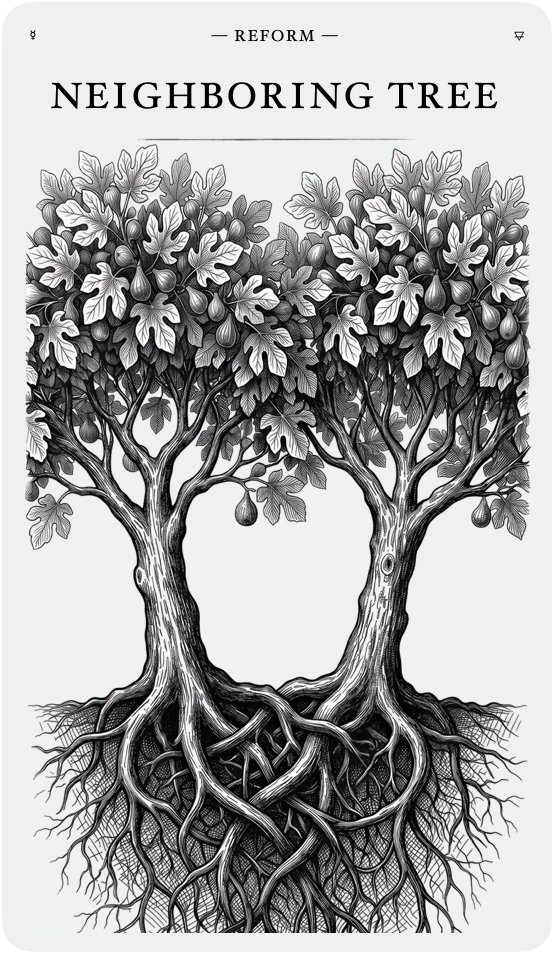
Where did you discover that what held you was never yours alone?
Sit with the question before answering it. The piece does not have to mention the tree, the card, RADIX, or the prompt itself.
500–1,000 words
Periodically, one card from the RADIX Oracle becomes an open writing prompt.
The prompt is an entrance, not an assignment. Write from the question directly, disagree with it, or discover halfway through that you were writing about something else entirely.
Selected pieces may be developed collaboratively and become future RADIX essays.
Only work that earns its place.
The five Rules of RADIX govern everything published here.
- No borrowed wisdom.
- Write only what earns its place.
- Return abstraction to something living.
- Esoteric, never doctrinal.
- No advice. Only perspective and space.
The original five govern the work. A few additional constraints govern this practice.
Begin with something lived.
Not expertise disguised as certainty. The interesting question is what happened when what you know encountered your life.
Write after the experience has had time to change you.
Lived does not mean immediate. We are interested in recognition, not reaction.
Protect the lives around yours.
Do not expose private information or make unnecessary identifying claims about people who appear in your story.
No promotion.
No company. No product. No newsletter. No campaign. No personal brand disguised as an essay.
Tools may help edit. They may not author.
AI may question, cut, edit, reorganize, or challenge the writing. It may not substantially draft the essay. Permitted use is disclosed on the submission; disclosure does not disqualify the work.
The work should have changed the writer
before it reaches the reader.
Submitted
Your piece enters editorial consideration. Submission does not guarantee a response, selection, editing, or publication.
Selected for development
If I believe something in the piece is worth working toward, I may invite you to develop it with me.
If a piece enters development, I reserve at least seven days before its intended publication date to work together. If the piece needs longer, it moves to a later issue. Quality outranks the calendar.
I may suggest cuts, ask questions, challenge an explanation, or propose structural changes. You remain the writer and may decline any edit.
An invitation to develop a piece is not yet an acceptance for publication. Either of us may decide during this process that the piece is not ready.
Accepted for publication
If we arrive somewhere we both believe in, I will formally accept the final version for publication.
At that point, we will execute a short contributor agreement. You will see and approve the exact version that will be published.
Published
The essay appears in RADIX under your name or agreed pen name and is distributed through The Letter.
Published contributors receive a signed copy of RADIX.
Submitting an essay does not transfer its ownership to RADIX.
If your work is published, you retain your copyright and remain free to publish, adapt, expand, or submit the work elsewhere. RADIX receives only the limited permission necessary to publish and preserve the final version we approved together.
No monetary compensation is offered for publication. The signed book is a thank-you for contributing to the practice.
Enter the practice
You do not need credentials.
You do not need to call yourself a writer.
You do not need to have read the book.
You do not need to be a subscriber.
You need something you have lived long enough to see differently.
Or send this prompt to the person it made you think of.
One submission per prompt · English only