You are not one person. I don't mean this mystically. I mean it practically, structurally, exhaustingly. You are whoever your boss needs in the morning standup. Whoever your partner needs over dinner. Whoever your parents need on the phone. Whoever the internet needs you to be in your carefully curated feed.
And you're exhausted—from the switching. From maintaining the performance that the performance isn't happening.
You've been taught you are the problem. When motivation fails, look inward—find your why, unlock your potential. As if motivation were buried inside you, waiting to be harvested. But what if the problem was never you?
Energy follows structure. Each time you switch contexts, you're not just changing masks — you're changing the laws of gravity. What makes you valuable at work makes you cold at home. What makes you safe at home makes you invisible online. And at every transition, energy leaks.
Fragmentation reads as lack of motivation because the cognitive cost of performing multiple selves is invisible — even to you. You feel broken. You're not. You're trying to run incompatible architectures in one body.
The work is to build structure flexible enough to hold who you actually are — without leaking at every seam.
Who This Is For
For the people who've read the books, done the routines, tried the apps — and still feel like they're pouring energy into systems that were never designed to let them win.
For anyone who suspects the exhaustion is structural. For those tired of being told to optimize harder inside containers that were broken from the start.
In Their Words
"A wake-up call I didn't know I needed. This is a mirror."
— Therapist · Austin · Pre-read group
"I kept waiting for the part where it tells me what to do. It never came. And that was the point."
— Creative Director · Los Angeles · Pre-read group
"I've read it twice. The second time I understood something completely different. That's the design."
— Founder · Chicago · Pre-read group
“Rarely does something come along that rips through all the noise with a sword made of silk.”
Rarely does a work transcend the very genre it explores in a way that creates a new form of expression with existing mediums. In a world doomed with digital dopamine over-stimulation, true needles in haystacks become impossible to find.
He has somehow created an interdisciplinary work with such intention, care, and craft, that it asks more from its reader, enabling access to much deeper dimensions.
In just under 150 pages Radix packs the most unexpected punch — concisely praising while rebuking every self-help tool, book, and guru you have ever encountered while pulling the ultimate jiu-jitsu trick, taking the reader on a journey that envisions inner architecture as a dynamic energy ripe for abundance.
As you read it, Radix will seem familiar yet forbidden, incisive but intricately woven, self-aware without obnoxious tongue-and-cheek postmodernist tactics.
It turns the lethargy of today's digital crisis of consciousness, fractured identity, and me-too promotion into something literary, artful, and sublime.

What's Inside
A book organized in movements, not chapters.
Each marks a structural shift in how attention, effort, and identity are held.
An honest beginning
Where momentum is paused long enough to see clearly.
— Part I —
The Performance
A diagnosis of where motivation leaks — how attention is extracted, effort is misdirected, and identity fractures inside a consumer-driven economy.
Interlude: The Self-Help Autopsy
— Part II —
The Reprise
Recovery without force. Orientation rebuilt around what endures once striving loosens.
Interlude: Transmutation
— Part III —
The Continuance
What follows clarity. How reorientation becomes contribution — and effort begins to move outward, intact.
The ground was always moving
A closing invitation.
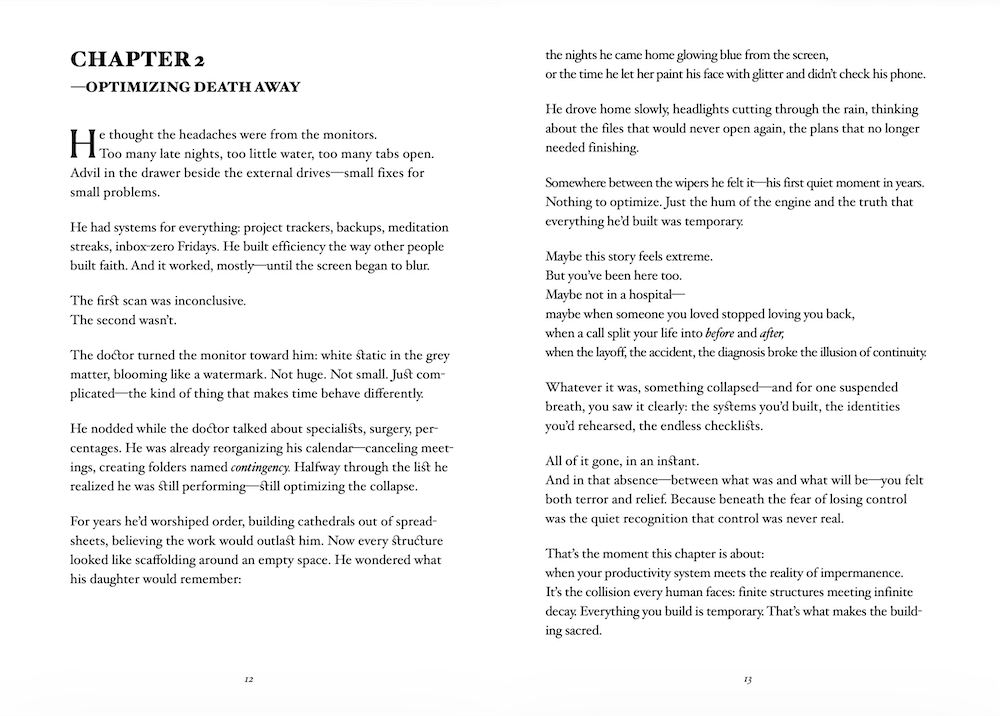
146 pages · original illustrations throughout
Built to be returned to, not consumed.
RADIX proposes that the reason effort drains away — the reason capable people stall, cycle, or exhaust themselves without moving — is architectural mismatch. You are operating inside a structure that was built for a different configuration than the one you currently occupy.
The book names this condition. The question the book leaves open is: which structure are you actually in?
Accumulation. Decomposition. Expansion. Restructuring. This cycle is an observable pattern in ecosystems, organizations, and human consciousness — a recurring architecture that appears wherever complex systems self-organize over time.
The four movements of RADIX — Root, Rot, Reach, Reform — are phase states. Every person expresses all four simultaneously. What the profile measures is which one is currently dominant in your system, and whether it is producing coherence or consuming it.
The book is a philosophical argument. The RADIX Structural Profile is what happens when that argument is asked to become precise — when "you are in the wrong structure" demands an answer to the question: which one?
The RSP is a psychometric instrument built on validated trait science (HEXACO) with a forced-choice structural layer on top. It does not measure who you are. It measures where you currently are within a cycle — and whether the energy moving through that phase is producing coherence or consuming it.
Five independent research traditions — working in different domains, with different methods, across different decades — arrived at structurally equivalent conclusions. When that kind of convergence exists, the claim carries a different epistemic weight. The RSP does not propose a novel theory of consciousness. It proposes a novel measurement of a well-observed phenomenon.
You are accumulating force. Something is consolidating beneath the surface. You feel the pressure before the move. Everything is preparing — but nothing has shifted yet.
You are extending. Energy moves outward, toward what pulls. Growth feels urgent. But not every direction that feels like growth is growth — and the difference is structural.
Something is dying. A belief, a role, a system that used to work. The most dangerous structures are the ones you can't see clearly anymore. They don't disappear — they consume.
You are rebuilding. The old architecture is clearing. What comes next is different. New ground. New gravity. New cost. The question is what you carry forward.
One essay and something to sit with. Ideas that keep working after you close them.
Joined by 400+ readers · No noise · Unsubscribe anytime
If it finds you at the right moment,
you're welcome to pass it along.
When does it ship?
Each copy is bound individually by an artisan bindery. Allow two weeks from order to dispatch — your number is assigned at the time of binding, not before. You'll receive tracking once yours is prepared.
Why is it priced at $88?
Most books are priced for consumption. This one was built for return.
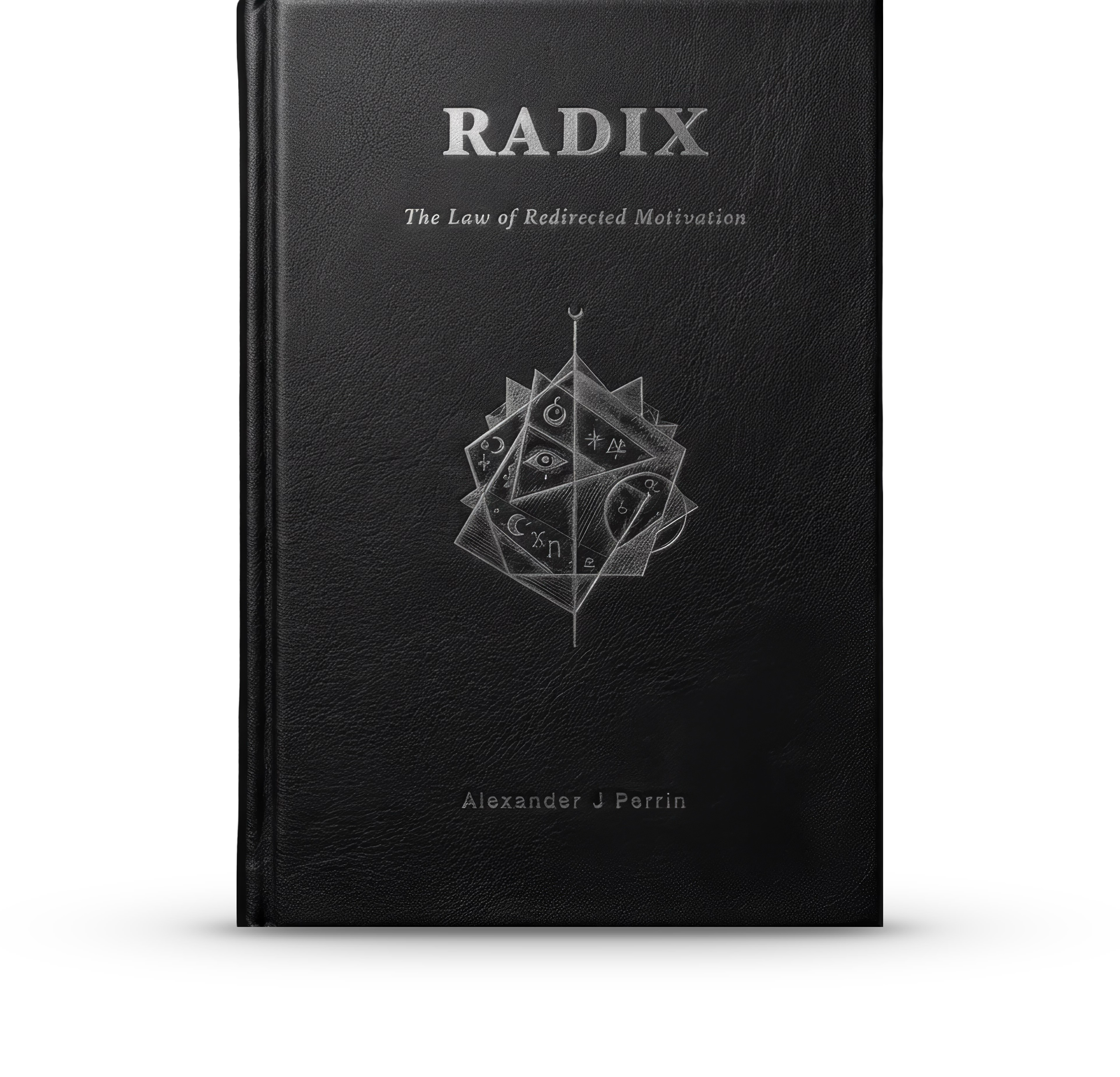
Each First Edition copy is bound by Grimm Book Bindery — a family bindery in Madison, Wisconsin that has been working in traditional leather methods since 1854. Not a print-on-demand facility. Not a fulfillment warehouse. A craft practice, passed down across generations, that still cuts, folds, and sews by hand.
The cover is leather-bound — chosen for durability and hand, not display. The paper is archival. Each copy is hand-numbered at the time of binding — meaning your number is not assigned in a spreadsheet, it is pressed into an object. The original illustrations were commissioned specifically for this edition and will not appear in the standard release.
The construction is meant to hold up to years of annotation, handling, and rereading. Books built this way don't deteriorate — they record. The price reflects the making. So does the limit of 500.
Will there be a standard edition?
Yes. A softcover General Release is coming in Summer 2026. Same text. Different object — no leather, no hand-numbering, no archival materials. More accessible. The 500 First Edition copies are the only ones of their kind. When they're gone, the standard edition is what remains.
What is RADIX beyond the book?
RADIX began as a book, but it has grown into a framework with multiple expressions. The RADIX Structural Profile is a free psychometric assessment. The Practice is a daily companion app. The Essays are original writing published bi-weekly. The Artifacts are physical objects — an oracle deck and archival prints. The Letter arrives every other Sunday. Each expression works independently. All of them draw from the same root system.
What does the Profile measure?
The RADIX Structural Profile (RSP) is a 52-question psychometric instrument, free and open to anyone. It measures your current motivational structure — which of four phase states (Root, Rot, Reach, Reform) is dominant in your system, and whether that configuration is producing coherence or consuming it. It does not assign a fixed type. It reads your present architecture. The result includes your dominant movement, your archetype, an emergence-entropy reading, and a developmental edge — the growth vector available from where you currently are.
What is the Practice?
The Practice is a companion app — available on iOS — designed for returning to the ideas in quieter moments. You draw a card, sit with a reflection, notice what shifts. There are no streaks, no tracking, no productivity metrics. It moves slowly on purpose. The Practice is built for the kind of attention the book asks for.
Is this a book for everyone?
No. RADIX doesn't resolve cleanly. It doesn't offer a system to install or a method to follow. It asks for attention, patience, and a willingness to sit inside a question longer than feels comfortable. If you're looking for a better frame — it might be.
First Edition purchases are final.